Followers

Monday, 6 May 2013


Again - 3 days for the price of one. We had a very poor internet signal on Friday & Saturday at Stone and none at all yesterday at Barlaston. Thank heaven's for Westport Lakes and the Potteries!
Monday May 6th
What a perfect day! Bright sunshine from the start and it’s lovely & warm! The weather obviously isn’t aware that it’s Bank Holiday Monday!

Wedgwood Factory
Under way at 7.20 we were soon past the moored boats on the Wedgwood Factory moorings and heading for the first lock of the day. This is Trentham Lock, situated on the outskirts of the Potteries suburb of the same name.

Trentham Lock
Because of the antics of the “little darlings” an anti-vandal device has been fitted to the top ground paddle only in an effort to deter their predilection for raising the paddle and wasting water. However, the top paddle is out of action completely anyway. As this is a very deep lock – just an inch shy of 12’ – it took a long, long time to fill.

The rather dreary suburb of Hem Heath follows. If there is an old, historic core to the place, the canal doesn’t find it. To while away the monotony of suburbia one is forced to compare the efforts of the local population in back garden attractiveness terms.

It is amusing to see the effect of the BBC’s Ground Force team. Clearly some householders were sufficiently enthused at the time of the programme’s heyday, but after, what, 12 years or so, some of the timber decking is looking decidedly ‘tired’.

Once free of suburbia, a short period of that scrubby, horse paddock pastureland follows of the sort that you find clinging to the fringes of most built up areas. The railway line closes in again on one side and then, on the other, the attempts of Mother Nature to reclaim the dereliction man has left after the closure and demolition of the buildings of Sideway Colliery are evident in the scrubby wasteland. Part of this area is slowly being colonized by large identikit warehouse style buildings so common these days. Two brick built cottages dating from the early part of the C20th stand sandwiched between the canal and railway looking rather incongruous in their present surroundings. Were they railway cottages, canal cottages or something to with the colliery –perhaps something to with colliery to railway interchange sidings?

The towering stands of the Britannia Stadium (home to Stoke City FC) rise up on one side with the council’s waste incineration plant with its tall chimney on the other. The waste plant is a mirror image of the one adjacent to the Wolverhampton 21 – both built alongside canals, but disdaining any connection and no hope of using water transport over King Road.

A major road junction and bridge starts a mile or so length featuring alternately brick and concrete canyons in which the canal is forced by modern road improvements and old industry. Readers of this log will be aware I infinitely prefer the latter.

The old industry includes the dereliction of the former site of Kerr Stuarts, the major engineering firm where Tom Rolt was an apprentice until bankruptcy caused their closure, and the former North Staffordshire Railway workshops – now home to a variety of small businesses. A wagon works, or at least somewhere where wagon wheels are produced still hints at the area’s former railway influence and, surprisingly, it was working on a Bank Holiday.

Diversification in the Potteries
A boatyard where we have never seen a soul and which is full of old fibreglass cruisers with no current licenses has an interesting sideline in activities offering line dancing, country & western, air rifles, archery& tacle (yes it is spelt that way) and bait amongst its boat engine services.


Stoke Bottom Lock
Crossing over the River Trent – now considerably smaller in size even than when we first met it at Great Haywood – a long brick canyon takes us to Stoke Bottom Lock. When major road “improvements” were carried out in the 1960’s, the bottom two locks of the Stoke flight had to be combined in one new concrete lined and deep lock. Subsequent road “improvements” carried out a few years ago negated that need with a revised road system. So the powers that be could have left things alone if they’d thought about doing the C21st improvement first.
Former lock house


A new lock house built with the new lock still stands alongside but now in private ownership.

As we approached the second lock – Cockshutt’s Lock (named after the adjacent railway sidings) – we saw the bottom gates
Cockshutt's Lock
opening. Ah –there must be a boat coming out. But there was no boat in the lock. What was going on?


We had met up with Robert, known locally as Rob the Lock. He is a youngish chap who, whilst not being an official C&RT volunteer lockie, acts as one with their tacit approval. He did the training last year but was unhappy with the placement C&RT came up with for him – Newcastle Road Lock at Stone.

Old factory at Twyford Lock
He prefers to be mobile and act as a lock-wheeler, using his bike to get from lock to lock. He kindly helped us up the rest of the flight. He told me that he just loves helping people through the locks and doesn’t mind how far he has to go. He has twice helped single handed boaters from Stone to Middlewich and vice versa (being offered a bed for the night half way along) and he has also helped boats up as far as Stockton Brook on the Caldon.

We said farewell to him at the top lock where he jumped on his bike and pedalled down to meet up with a boat that we had just exchanged places with.

Not far to go now to our usual mooring in the Potteries. First though we traversed the mixture of old and new (mainly old) with the Festival Park developments and new industrial units interspersed with remains of old brick walls, the still derelict remains of the Shelton Steel Works before entering what for me is one of the most redolent areas anywhere in the country that brings a real sense of the activity that must have gone here for years before closure, abandonment and dereliction set in.

The area from the erstwhile Burslem Arm through Middleport and Longport is one of despair and hope. Despair that so many old industrial buildings are just quietly mouldering away, and hope in that some factories are still working, one in the process of being rejuvenated.
Dereliction at Middleport


Former Anderton Canal Company's loading bay
Middleport Pottery
The latter is Middleport Pottery. Here the entire complex was bought by the Prince of Wale’s Charitable Trust with a view to restoring the buildings to provide an educational facility and tourist attraction as well as keeping the pottery going and setting up premises for other small craft businesses to make their home. There is plenty of restoration work going on.

Restored warehouse at Longport Wharf
At Longport Wharf, the old canal warehouse that suffered major fire damage a few years ago is now fully restored.


Dereliction at Longport x1
 
 
Dereliction at Longport x2
And then, through another short section of closed pottery works complete with bottle kiln, we went through a bridge and in front of us stretched the long line of moorings that adjoin the popular Potteries green area – Westport Lakes. Here we tied up to gather our wits for the passage through the infamous Harecastle Tunnel and strength for the start of Heartbreak Hill tomorrow.
 
Mooring at Westport Lakes


Sunday May 5th
We enjoyed our stay in Stone as we usually do. It is a pleasant town which goes out of its way to welcome its canal visitors. The Farmers’ Market was excellent and we picked up some lovely locally produced cheese, crusty bread, big field mushrooms and all sorts of other goodies. The meal last night was excellent. We have now had lovely meals in Stone on three different occasions – Thai, Tapas and now Italian.
Star Lock at Stone

We thought we had excelled ourselves this morning untying at 7.15, but another Challenger boat had gone by just a couple of minutes before. So it was a case of waiting at the bottom lock (Star Lock) whilst ‘Verity’ went up in front of us. Apart from the two boats there was hardly anything else moving at all. The crew on ‘Verity’ helped us at the second lock (Yard Lock) by raising a bottom paddle.

We pulled in for a few minutes at the sanitary station below Newcastle Road Lock to empty the loo and get rid of the rubbish before continuing up to the last of the four Stone locks, Lime Kiln Lock. Past Roger Fuller’s boatbuilding yard are more moorings and here we passed Andrew & Pauline on ‘Griffin’ who we had shared locks (and the tidal passage) on the lower Grand union and Thames a few years back. They had passed us yesterday and slowed down for a quick chat.

At the foot of Meaford Locks we could see ‘Verity’ climbing up the second lock, but by the time we got to the third of the four lock flight, we were right behind them and returned the favour by closing the top gate for them on this and the top lock.

Above the top lock the canal runs through the first mundane landscape since leaving Wolverhampton. Although wooded, the landscape is healing itself after coal extraction and a former power station finally bit the dust. The site of the power station is still blighted by demolition rubbish and an electricity sub-station, but matters improve as the canal enters Barlaston. Here we passed ‘Verity’ – they had evidently got off for a paper or supplies – just as Elaine did. I carried on to our usual mooring spot just before the official visitor moorings for the Wedgwood Factory.

Mooring at Barlaston
It seemed strange tying up at just before 10.30 in the morning, but we had done our usual three hours and to go onto the next possible mooring spot – either at Etruria Junction, or as we prefer at Westport Lakes – would have meant a long day. We’ll leave that for tomorrow!

 
Friday May 3rd
After a wonderfully quiet night at Tixall Wide, we set off for the morning’s cruise to Stone. We seem to have dropped seamlessly into having the alarm clock set for earlier than we have done before in previous cruises (except for special circumstances) and getting good early starts –before 7.30. To some boaters I am sure this is quite late by comparison with their routine, but it’s fine for us. We get a good start without too many boats around – indeed some days we travel for an hour or more without seeing another boat on the move.

It is only a mile or so from the Wide to the junction at Great Haywood and the northern terminus of the Staffs & Worcs Canal as it makes a T-junction with the Trent & Mersey Canal here.

Most of that mile is a procession of moored boats on both sides followed by twin aqueducts. The first is over the River Trent, whose valley we now follow, at least as far as Stoke. The second is now over nothing in particular but was presumably over an earlier mill stream. The remnants of the mill complex have been subsumed into and are surrounded by modern industrial units and one entrance under the aqueduct is now part of a concrete yard and driveway.

Immediately following is the end on moorings of the Anglo Welsh hire base with one of their longer boats moored rather inconsiderately close to the exit from the second aqueduct calling for some fairly tight and accurate steering.

A long blast on the horn probably woke up every boater on the visitor moorings who was still in bed (most of them) and a burst of throttle and with the tiller hard over we swung round to the right and headed for Stone.

Again progress is slow as most of the next mile has off side linear moorings. Most of these are from the relatively new marina, but also from the small mooring basin and linear moorings at Hoo Mill Lock – our first of the day.

It was here that a boat that had left Tixall shortly after us came up as we ascended the lock. It was one of the former Challenger share boats ‘Invincible’ which, as we later ascertained, was making its way back to Aston Marina, just before Stone.

From Hoo Mill to Stone is another of those understated, typically English landscapes as the canal parallels the Trent with low ridges of hills marking the valley edges on both sides. It is an open landscape with, apart from the river banks, few trees. It is also a stop-start sort of progress with moored boats dotted all the way to Stone. It is rightly a popular section, with large marinas at either end. The main Derby-Stoke road, the A51, and the main railway line shadow the canal to the north and east, occasionally dipping their toes into the canal world by running down nearer the canal in places, but it is essentially peaceful and tranquil.

A private boat pulled out behind us soon after Hoo Mill so we now had two boats trailing us. At Weston Lock another former Challenger boat was tied up - ‘Victorious’ – but we were able to ascend without having to wait. As the private boat pulled into the lock landing for the next locking, ‘Victorious’ pulled up behind us meaning that‘Invincible’ was now fourth in a queue.

As we entered the outskirts of Weston upon Trent came one of those moments that seem to happen quite frequently in the canal world and act as a reminder that Sod’s Law is alive and well in the C21st – namely that if you are going to have to pass a boat it will happen in the most awkward location possible.

Sure enough as we approached the moored boats outside Weston Wharf we met a boat heading for Great Haywood. Nothing too sinister in that you might think, but at the point where we would pass the boats were three abreast on the wharf and a curve in the canal’s course occurred immediately after.

Fortunately we all seemed to know what we were doing (or it was just blind good fortune) and we managed to pass without clouting anything, going aground or any of the other highly unpleasant and embarrassing options that could have happened.


Ornamental bridge
Canal, railway and road are squeezed into a narrow channel as the village of Salt is passed to the south west, and Sandon Hall & park on a ridge to the north east. An ornamental bridge, insisted onby the local landowners at Sandon Hall, takes a minor road over the canal before we reach Sandon Lock. Here we all started to stack up. Two boats were in front of us and by the time they had moved through, we were the first of four boats waiting our turn. It seemed quite alien for us as this was the first time on this cruise that we have had to queue and wait at a lock.

Waiting at Sandon Lock
Eventually we were through and on our way through more of the same landscape, although we do pass salt meadows – now a nature reserve which, with the earlier village of Salt, give a clue to the former industry that prospered in this area since Roman times.

Although we had lost one of the boats in front of us into Aston Marina, another had exited from the marina’s exit channel (they have both in and out channels) in front of us. This meant another further delay at Aston Lock, but we were in no hurry – our destination was only a couple of miles or so in front of us and after Aston Lock we had no more to work today.

Aston Lock
A boat descending warned us about the pound above Aston Lock which, they said, was about 8” down. And sure enough, once through the lock, we struggled to make any speed over the final mile and a half to our intended mooring place.

We had to keep to the centre of the channel as the sides were both well exposed and mud and rocks, normally buried under a few feet of water, were now exposed. Indeed we thought we wouldn’t be able to get into the side at Stone at all.

When we reached the long length of moorings it wasn’t the depth we were initially worried about – just that there didn’t appear to be any spaces left for us to use. Fortunately, there were about two boat lengths left before the winding hole and we made for the side. Well, the bow made it to the bank, but the stern ended up about a foot out. Nevertheless, we have tied up in worse places and before too long we were closing the boat up and heading for Morrison’s for a refill of the store cupboard.

We found out from the boater moored up behind us that there had been a problem at Aston Lock overnight with neither set of gates, top nor bottom, being able to be closed properly with the result they leaked all night semi-draining the pound up to Stone. Early in the morning it was 18” down and moored boats had a decided list. Someone had already been in touch with C&RT and additional water was being let down with the result that it was now only about 6-8”. By the time we got back from the shop it was much better and by the evening it was back to normal.

We had found out that the Stone Farmers’ Market is held on the first Saturday of the month in the main pedestrianised street, and we wanted to visit this. So we decided to make our stay in the likeable town of Stone a two night affair, and also celebrate nothing in particular by having a meal in the lockside Italian Restaurant.


Thursday, 2 May 2013


Although we have enjoyed a couple of warmer days, it is still noticeably cooler at night. So much so that when we rose this morning there was a light frost on the roof and ropes. Despite the better weather, it is still necessary to light the fire in late afternoon or early evening.

With another early start (7.25) we had a short hop to the sanitary station adjacent to Penkridge Lock where we disposed of rubbish and emptied the loo. Whilst the lock was filling Elaine nipped next door to the shop to get a paper.

Through the lock where we passed Brenda & Brian Ward’s boat ‘Colehurst’ (they return tomorrow to the boat for the weekend) and Tracey Arbon’s boat ‘Tea Clipper’ (Facebook friend), we soon exited from the last houses of Penkridge and started out on a journey through some of the nicest, most understated countryside the Midlands has to offer. The canal now joins the tiny River Penk and drops down a number of locks which become more spaced out and shallower as we drop down towards the Trent.

Longford Lock and Park Gate come and go and by now the sun is really beginning to generate some warmth so the layers are swiftly shed. Park Gate Lock is the headquarters of Teddesley Boat Company who used to run a fleet of hireboats. It was on one of their boats that I had my first involvement with canals with a week’s cruise on the Black Country Ring in 1975. The rest, as they say, is history!

Between Longford & Park Gate Lock, the M6 becomes a nuisance again roaring up alongside just a field’s width away before crossing on a long tunnel like bridge as it, unusually, crosses the canal on a skew.

The landscape hereabouts used to form part of the Littleton Estate base on the family home at Teddesley Park. After being used as a prisoner of war camp in WW2, it was demolished. The family owned a large acreage hereabouts including many collieries and ironworks.

Shutt Hill Lock
Shutt Hill Lock takes us alongside a minor road for some distance before the canal skirts the periphery of the wonderful named village of Acton Trussell. The village name conjures up images of rustic locals sipping their beer outside a thatched pub, yet the face it presents to the canal is one of C20th urbanity with very large executive housing with manicured lawns and landscaped gardens. A large modern hotel cum conference centre caters for wedding parties and business conferences. The church lies lonely and forlorn in the fields some distance from the village. One assumes there is an older, more attractive part of the village …. Somewhere.

The name of Acton Trussell should sound familiar to fans of the wonderful and irreverent comedy due Hinge & Bracket. The name, if not the location, of Acton Trussell was borrowed by Staffordshire-born entertainer Patrick Fyffe (aka Dame Hilda Bracket) in creating the fictional village of Stackton Tressel, home of the eccentric spinster musicians.

Cruising near Acton Trussell
Thankfully the motorway now moves out of sight and sound as the canal enters a dreamy, remote section despite the proximity of Stafford, just a mile or so away to the west.


Cruising near Acton Trussel


Deptmore Lock
Deptmore Lock has a surviving original lock cottage. When we came this way a few years ago the cottage was completely derelict, not surprising as there is no road access to it. Last time it was noticeable that remedial work had started and the cottage is now thankfully fully restored and lived in. A track of loose chippings seems to have been laid round the adjacent farmer’s field to give access, which the postman was using in his van as we dropped down the lock. It is all very pleasant and bucolic.

Restored Deptmoer Lock Cottage
Stafford Boat Club Clubhouse & moorings
And yet, round the corner comes the large and impressive headquarters of the Stafford Boat Club utilising an old colliery arm for their moorings and the Stafford suburbs of Radford, Baswich and Wildwood. For a couple of miles the canal resumes concourse with the modern day world but turning course to the south east to join the River Sow (which has just subsumed the Penk – don’t you just love these names ..) the canal re-enters the dreamy world of river meadows backed by low hills as we approach the heights of Cannock Chase.

Aqueduct over the River Sow
The main line railway comes alongside in a flurry of Pendolinos and overhead gantries and the attractive gardens of a residential park home site add a splash of spring colour to proceedings. At Milford, when the heights become too high for comfort the canal sheers off to the north east following the Sow which it proceeds to cross on one of Brindley’s typical solid and low slung aqueducts.

Tixall Lock
What follows is just charming. The gardens from some very expensive properties drop down to the canal, the type of property where you employ someone on a sit down mower to mow your lawns for you. Tixall Lock is the shallowest at just 4’ 6” and comes with its whitewashed bridge and cottage – altogether a chocolate box image to treasure.

The anticipation is running high now as the canal slowly widens, turning a corner to reveal one of the quietest and loveliest moorings anywhere in the country in Tixall Wide. There are two schools of thought as to why the canal widens to such an extent here. One is that Brindley included a lake into the course of the canal; the other is that the owners of Tixall Hall wanted him to place the canal in a picturesque setting as the price for allowing the canal to pass through their land.

The Hall was demolished in the 1920’s, but the Elizabethan Gatehouse survives as do the remarkable semi-circular stables.

Anyway, whatever the reason, it is a stunning piece of canalscape and one we have used every time we have journeyed this way. Today was no exception and again we tied up here for a quiet and peaceful overnight stop.

Mooring at Tixall Wide

Wednesday, 1 May 2013


After a very quiet night (once the jogging club had returned from wherever they jogged to) we had another early start and were soon chugging past the final Wolverhampton suburbs. Council houses line the nearby road with long gardens running down to the canal edge. Many of them have turned them over to vegetable gardens and such is their size, it is almost like a field of allotments.

Pendeford Rockin'
A long line of sentinel-like poplars screen a large school’s playing fields before a final run of council houses lead us into one of the more unusual canal features – Pendeford Rockin’.

When the canal was built, the navvies encountered a short distance of hard rock which they found difficult to cut through. The result is a long narrow section where a couple of passing places have been provided as it is very much a case of one way traffic. The name Pendeford Rockin’ was given to it by the boatpeople – Pendeford is the local area and Rockin’ was their name for a narrows.
Pendeford Rockin'

50 or so years later the builders of the Birmingham & Liverpool Junction Canal (now the Shroppie) had the same difficulty a mile or so up from Autherley Junction.

Once through the narrow section a nondescript and rather down at heel length follows as the canal passes through Wolverhampton’s final industrial fling before being crossed by a massive concrete viaduct carrying the M54 motorway to Telford.

Open country finally arrives after the motorway, if spoilt a little by several electricity pylons carrying high voltage lines. These dog the canal for some way. We passed an Alvechurch hireboat from Anderton festooned with loads of orange balloons. Greeting the occupants they advised us it was their coronation day. We were a bit bemused to start with before realising they were Dutch and celebrating the coronation of their new King.

In many ways I prefer the northern section of the Staffs & Worcs Canal from Aldersley/Autherley to Great Haywood over its far more fêted southern section down to Stourport. The countryside is just gentle and fairly flat pastureland, but well wooded in places. Occasional longer views open up from time to time to the prominent chimneys of the chemical plant at Four Ashes – more of which later, and the TV mast atop Cannock Chase that is such a feature of the Coventry, Trent & Mersey and Staffs & Worcs Canals that skirt the Chase.

It is also evident that we are on one of the first narrow canals built in the early phase of canal construction as it winds its way around the contours as much as possible with narrow brick built bridges usually sited on a bend.


Approaching Hatherton Junction
Hatherton Junction
The type of landscape is evidenced by some of the small settlement names – Coven Heath (is that where the witches meet?), Slade Heath and Calf Heath. A two mile meander as we box the compass avoids a small ridge which the later railway cuts off in its direct route from Wolverhampton to Stafford. At the apex of the meander, the Hatherton Branch bears off to the right. It once climbed up a series of locks to make a junction with the BCN’s Cannock Extension Canal. Closed long ago, only the first few yards and the first lock are still extant, the latter in use as a marina’s dry-dock. The route (more or less) now forms the western part of one of the restoration schemes we support – the Litchfield and Hatherton.

A few more bends of the canal as it unravels itself from the meander brings us to Four Ashes and the aforesaid chemical plant. The chimneys are visible for a long way around and appear in all directions as the canal winds itself round the contour. Also clearly visible is a huge new complex under construction looking more like a futuristic sports arena. It is in fact a new waste to power plant.

The actual chemical plant was originally a tar distillery and despite being in such a rural location has been adapted and enlarged and looks to be a thriving concern now in the ownership of the wonderfully named American owned Schenectady Chemical Company. It apparently manufactures resins, vinyl pyridines, xylenols and isobutyl benzene and if you know what they do or make, you’re a better man than I!

The works’ own bridge is now named after the company and is soon followed by a series of pipe bridges. Former buildings associated with the works on the off side have been demolished, but a patch of grass supports a flourishing colony of daffodils amid the heaps of rubble and debris.

Approaching Gailey Lock
The canal, after disentangling itself from the environs of the works, now makes for Gailey. Gailey Lock marks the end of the canal’s summit level and also where the Roman Watling Street (as amended by Telford) crosses the canal. Permanent and visitor moorings, a boatbuilder, a hire base, and the lock and sanitary station all add up to a jumble of boats that need to be negotiated. We were fortunate in our timing as a boat was just exiting the lock as we approached enabling us to go straight in. Similarly, another boat arrived below so saving Elaine much hard work!

Gailey Roundhouse
Gailey possesses a notable canal feature in its roundhouse. This was built as a toll house and is built in the style of a small battlemented lighthouse. As far as I know, it is unique; one other example on the southern section of the canal at Gothersley having been demolished years ago. It is always in immaculate condition, the ground floor housing a canal shop with the owner’s living accommodation in the floors above.

A flurry of locks start the descent down to the River Trent – Brick Kiln, Bogg’s, Rodbaston and Otherton following on from Gailey in swift succession. The rural peacefulness of the first two is a misnomer as the C21st century makes its noisy and uncouth presence felt with the M6 roaring alongside in a flurry of HGV’s.

On the approach to Rodbaston Lock we passed Alan Cazaly’s boat “Pengalanty”. Alan & I belong to the same canal forum on Facebook.
Site of Rodbaston Lock Cottage - motorway on the left

Rodbaston Lock Cottage was rebuilt with the coming of the motorway, even being provided with its own access bridge over the motorway. However, the lock keeper only lasted in the new cottage a short while before he fled for a house in Penkridge as the noise was too great. If it was loud when the motorway opened, you can guess what it’s like now. Anyway, Elaine was happy as she saw a number of Eddie Stobart lorries.

18th century lock & bridge, 20th century motorway
At Otherton Marina we passed Alison Tuck’s floating art studio “Da Vinci” – another friend from Facebook. We greeted Alison as we passed.

'Pisser' in Filance Lock


Immediately after, we encountered our first fishing match of the cruise. A long line of poles stretched out before us past The Cross Keys pub and right over the designated 48 hour visitor moorings where we had intended to tie up. We had to go down the next lock – Filance Lock (complete with its own pisser – that’s a water leak in the wall’s brickwork to non-boat people) and use the next set down opposite the primary school.
Mooring at Penkridge

Tuesday, 30 April 2013


We knew today would be a longish day (by our standards) with about 9 miles to cruise and 21 locks to work through, so we started quite a bit earlier than we have been doing and were under way out to the main line at 7.30.

We had a very quiet but pleasant cruise on a lovely spring morning with blue sky and sunshine in intensely urban but not unpleasant surroundings.

Rejoining the main line and turning left at the top of Factory Locks we headed for Coseley, passing en route not just several entrances to railway interchange basins, but also the now blocked off entrance to the Wednesbury Oak Loop, one of Brindley’s long looping bypasses of difficult ground – in this case Coseley Hill. The newer and straighter section through the hill via the double width tunnel was the only route improvement made beyond Tipton, the remainder of the route follows the contours in a gently winding journey.

The towpath beyond the tunnel is used by schoolchildren to access a local school and, passing a number trudging their unwilling way to lessons, we realised that we were quite a bit earlier than usual!

At Hills Bridge, we were surprised to see that The Boat Inn had been razed to the ground since our last journey along here a couple or so years ago – needless to say nothing has been built on the site.

Just after the arm that used to house Alfred Matty’s old yard the other end of the Wednesbury Oak Loop rejoins the Coseley route. The first couple of miles or so are still navigable to the C&RT depot at the end at Bradley that manufactures lock ironwork and gates.

Passing the site of the former Spring Vale Ironworks at Bilston (still working into the 1970’s) it was hard to believe this was the place of work for thousands of men with blast furnaces working 24 hours a day and is now covered by …… houses. A sort of elongated childrens’ playground roundabout and built, presumably, of steel is no doubt a sculpture of note, recalling the heyday of the works. Other less charitable people like me call it a nonsensical and meaningless waste of money.

Whilst the surroundings have been predominately industrial – albeit much of it now demolished and abandoned, there are occasional green areas and housing. But the canal outskirts of Wolverhampton were always heavily industrialised, and quite a bit of metal bashing still goes on.

At Chillington Wharf a roving bridge rises over the arm into a former railway interchange basin, still in water and with its overhead gantry and crane in situ. It is now Grade II listed, but leads a precarious existence as rust eats away at the structure.

Former Chubbs Locks Building in Wolverhampton
Factories now line the canal on both sides as we enter Wolverhampton proper. Horseley Fields Junction (no horses and no fields now) heralds the junction with the Wyrley & Essington Canal as it starts its long lock free journey to The Sneyd, Birchills, Catshills and Anglesey Basin.

Under a cavernous bridge euphemistically called Wolverhampton Tunnel, the canal passes an old arm (the former canal route before railway expansion forced a change) and old warehouse, a couple of grassed over wharves before arriving at the top of the long flight of locks that will take us back out to the country and the Staffordshire & Worcestershire Canal.

Wolverhampton Top Lock
Our hearts immediately sank as we could see a boat descending the top lock just in front of us. That meant that all the locks would be against us and would need refilling before we could enter. Worse still it turned out to be a single handed boater which meant progress would be even slower. Not that we have anything against single handers. On the contrary, we admire then for the hard work they put in. It’s just that you don’t really want them in front of you in a long flight of locks.

Underneath the arches - tall LNWR & lower GWR viaducts
We met one boat around the fifth or sixth lock which enabled him to get a bit in front of us and he kindly raised a top paddle for us, and then tied up above lock 8 to “put the kettle on” and helped us through that lock. Better progress was made after that, especially after we passed another boat under the soaring arches of the first of two high railway viaducts.

Aldersley Junction, BCN ahead, Staffs & Worcs right to left
At lock 16, Elaine nipped to the shop opposite to get a newspaper and when through the second of the high blue brick viaducts we re-entered countryside with woods on one side and Wolverhampton Racecourse on the other. The last five or six locks are spread out a little more, and by the time we reach the bottom, immediately before Aldersley Junction, we are in verdant woodland.

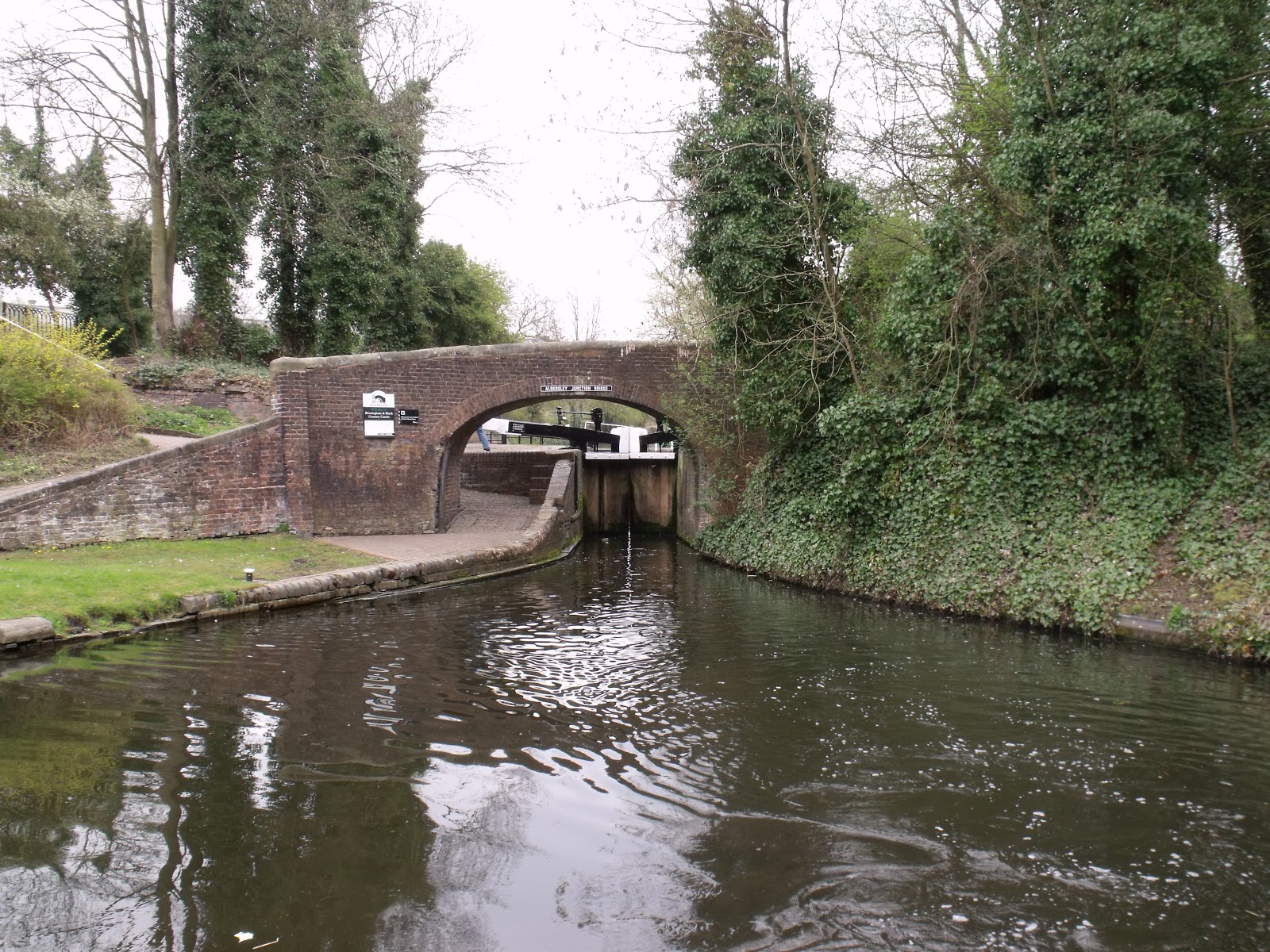
At the junction we turned sharp right to join the Staffs & Worcs Canal which has climbed up from Stourport and Kidderminster to the left, heading in our direction for Autherley Junction where the Shropshire Union Canal leaves it to the left.

And it is at Autherley Junction that today’s epic (again, by our standards) journey ends and we head indoors for a welcome sandwich. We tied up between the gaggle of boats at Oxley Marine and the distinctive roving bridge that marks the junction. Tomorrow we head straight on for Penkridge, Great Haywood & the Trent & Mersey Canal.

Mooring at Autherley Junction. Junction signpost on right pointing to Chester via Shroppie. Staffs & Worcs straight ahead

Monday, 29 April 2013


We are now on the move again after 3 very pleasant if a bit chilly days in Birmingham. After catching a train from New Street Station to visit Cadbury World on Friday, we met up with our friends Pete & Jenny Copeland who picked us up on Saturday morning to attend the Western Front Association’s AGM & Conference, which despite the title was most enjoyable.

Yesterday (Sunday), after a Tesco experience (oh dear!), we walked all the way down to the National Trust’s Back to Backs – a restoration of the last Court and Back to Back houses left in the City. It was well worth the walk to get there as they are a fascinating snapshot of a world that has long gone and made a pleasant change from the usual National Trust fare of stately homes and castles.

We will now head directly to Llangollen, cruising every day (except perhaps for a 2 night stay in Stone). Accordingly we headed off this morning in bright sunshine, but with a very cold wind, along the New Main Line to Tipton and the moorings at the Black Country Living Museum.


Derelict factories awaiting redevelopment
There are a number of different ways to get to our destination depending whether or not you want to try some of the more esoteric diversions (Old Main Line, Spon Lane Locks, Brades Branch or just to loop the loops of Brindley’s old line of the canal where they cut across Telford’s later and much more direct new line.

A rare working factory near Smethwick Junction
We opted for simplicity and just headed along the New Main Line disdaining the two remaining loops and the older line branching off at Smethwick Junction and following Telford’s brash, brave deep and wide new line. This carves through the landscape through cuttings and embankments and in broad straight lines much like the later railway that follows it so closely from Monument Lane to Tipton.
Pockets of the industry commonly associated with the BCN appears from time to time, but it fast retreating from the onslaught of demolition, retail parks, houses etc. Does this country actually make anything anymore?
 
 
Smethwick Junction

The M6 cossing
At Spon Lane the Old Main Line crosses over on a sturdy two-arched aqueduct, but the pleasing simplicity of its lines are totally overwhelmed by the huge pylon like legs that rise out of the centre of the channel and divide to support the M6 that towers above the canal.

In addition to the various branches that open up on either side (Spon Lane Locks and the link to the Walsall Canal form two of these) there are any number of roving bridges that take the towpath over the entrance to long lost colliery and factory branches or to former loading basins. Perusing a turn of the C20th Ordnance Survey map of the area reveals a multiplicity of arms and branches, many of which have vanished leaving no trace at all.

Beyond Pudding Green Junction where the link to the Walsall Canal bears off along Brindley’s original line to the Wednesbury coalfields, and through a skew railway bridge, the New Main Line stretches out in front of you in a dead straight line. Apart from negotiating the four narrows since leaving central Birmingham (the islands thus formed used to have brick built toll houses on them) there is little to do except set the steering to automatic pilot and turn the mind over to pondering life’s great imponderable questions – like will Peterborough United manage to get the result they need next Saturday to stay in the Championship?).

Junctions come and junctions go – Albion Junction where the Brades Branch bears off up 3 locks (including the BCN’s only staircase) to join the Old Main Line, and Dudley Port Junction where there is a link to the Dudley Canal through the high wide and handsome Netherton Tunnel (with the Old Main Line passing over on Tividale Aqueduct).

We had seen hardly any boats moving all day. An Alvechurch hireboat had headed towards us but turned right at Dudley Port to head for Netherton Tunnel whilst another boat had turned out of the Netherton Branch to head for Tipton.

This straight length of the New Main Line between Albion and Dudley Port passed through a fairly derelict area when it was built. Worked out collieries had been replaced by clay or marl pits. One of the last major commercial traffics on the BCN was bringing waste to be dumped in the marl pits – much of it of a highly toxic nature resulting in a lot of expense being needed to clean them up in more recent times.

A new housing development has inevitably appeared on this land and its boundary fence appears to hover uncertainly on the lip of one of the pits. I hope the toxic soil has been fully removed!

After Dudley Port Junction the canal, high on its embankment, passes over three aqueducts. The first over a major road is apparently called Ryland Aqueduct, but I know it as Spouthouse or Piercey Aqueduct. The second aqueduct, unnamed, passes over a long closed railway whilst the third with the charming name of Puppy Green Aqueduct passes over another, smaller, road.

A slight nudge on the tiller is now called for as a slight bend leads the canal past a small boatyard where the former and wonderfully named Tipton Green and Toll End Communication Canal crossed. The first part of the name related to the canal to the west that linked up three locks to the Old Main Line, the second to a linking canal extended through some more locks to link up with the Walsall Canal a couple of miles to the east.

Approaching Factory Locks
Climbing up Factory Locks
Then we get a bit of variety as the three Factory Locks appear in sight. These are quick and easy to work and made distinctive by the BCN’s policy of having single gates top and bottom. It was at the locks we caught up with the boat that had turned out of the Netherton Tunnel Branch some way in front of us. They had been having problems with rubbish getting caught around their prop and once through the locks pulled in so the chap could delve down into the boat’s weed hatch. As we climbed the top lock we could see all sorts of rubbish being pulled out – what looked like a fleece and the ubiquitous plastic bags and string. It turned out to be his third time down the weed hatch that morning! Oh the joys of cruising the BCN! At least he had cleared some of the way for us!

After leaving the top lock a sharp left turn took us onto the Old Main Line for a short distance as we progressed through Tipton, keeping straight on where the OML bears left onto the Dudley Canal that once led through the long, unventilated, narrow and very low Dudley Tunnel to link up with the Dudley Canal’s main line at Parkhead. The tunnel is now out of bounds to powered craft, and with the low headroom the opportunity to have your boat towed through the tunnel by one of battery powered boats of the Dudley Tunnel Canal Trust’s boats must be one accepted by very few boaters.

Needless to say as we approached the narrows at the start of the branch to the tunnel a boat appeared, leaving the moorings but turning right towards the OML and Birmingham.

The branch now just leads to the 48 hour visitor moorings and services set adjacent to the backdoor of the Black Country Living Museum, with the Tunnel Trust’s boats moored up beyond the winding hole.

We winded and tied up with just two boats for company, taking the opportunity to get rid of the rubbish, empty the loo and fill up with water.
Mooring at the Black Counry Living Museum